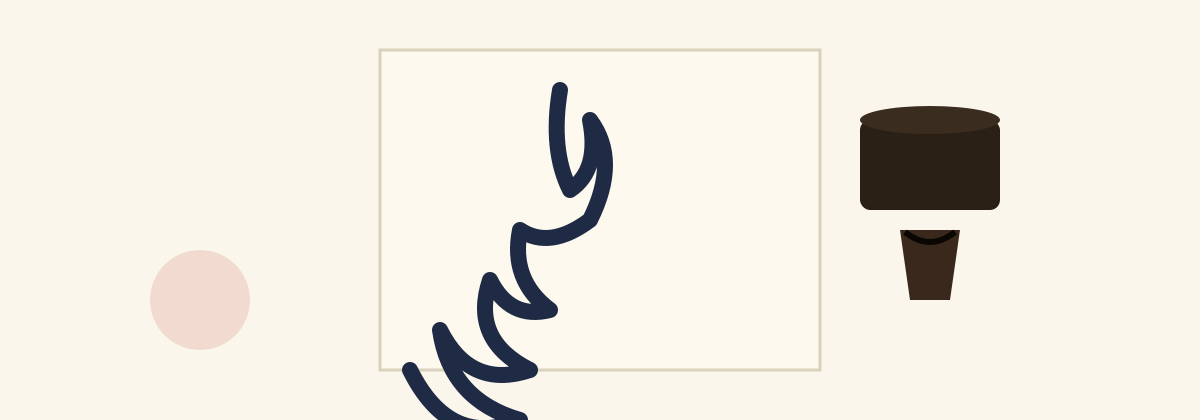
Shodo — The Art of Japanese Calligraphy
A single brushstroke, done right, is considered as expressive as a whole sentence. Here's what shodo actually trains, and the vocabulary behind it.
書道 (shodo, “the way of writing”) is the traditional art of brush calligraphy — a practice taught in Japanese elementary schools alongside regular handwriting, and pursued for a lifetime by serious practitioners. Unlike printed kanji, shodo treats the stroke itself — its speed, pressure, and the trailing ink at its end — as expressive content in its own right.
Shodo essentials
| Word | Reading | Meaning |
|---|---|---|
| 書道 | しょどう shodou | the art of Japanese calligraphy |
| 筆 | ふで fude | the brush used for writing |
| 墨 | すみ sumi | ink, traditionally ground by hand from a solid ink stick |
| 半紙 | はんし hanshi | the standard thin, absorbent paper used for practice |
Grinding your own ink is part of the practice
Before a serious shodo session even begins, practitioners grind a solid ink stick (墨, sumi) against a stone with a little water, slowly building up liquid ink to the right thickness. This isn't just prep work — the repetitive, quiet motion is treated as a way of settling the mind before writing, similar in spirit to the deliberate pace of Japanese tea culture.
The four treasures of the study
| Word | Reading | Meaning |
|---|---|---|
| 文房四宝 | ぶんぼうしほう bunboushihou | the “four treasures of the study”: brush, ink, paper, and inkstone |
| 硯 | すずり suzuri | the inkstone used to grind the ink stick against |
| 楷書 | かいしょ kaisho | block script — the clearest, most standard kanji style |
| 行書 | ぎょうしょ gyousho | semi-cursive script, faster and more flowing than block script |
| 草書 | そうしょ sousho | cursive script, highly flowing and often hard even for native readers to decipher |
Three scripts, three moods
楷書 (kaisho, block script) is the clean, fully separated style taught first and used in most printed text. 行書 (gyousho, semi-cursive) links strokes together for a faster, more flowing look, while 草書 (sousho, cursive) pushes that flow to the point where individual strokes blur into each other — striking to look at, but genuinely difficult to read even for native speakers without training.
One character, said everything
A common shodo exercise is writing a single kanji — 夢 (dream), 愛 (love), 和 (harmony) — as large and expressively as possible on a sheet of 半紙. The idea is that with only one character to work with, every choice of stroke weight, speed, and spacing carries the entire piece, which is why a single well-executed character can be displayed and appreciated the same way a full painting would be.
🔊 Tap any word in the vocabulary tables to hear it spoken.
More in History & Tradition
- Reiwa, Shōwa, Meiji — How Japanese Era Names Work
- Sun, Moon and Five Elements — The Japanese Days of the Week
- The Twelve Zodiac Animals (Eto) — Why Everyone Knows Your Birth Year
- Matsuri — Japanese Festivals, from Mikoshi to Fireworks
- Oshōgatsu — How Japan Celebrates New Year
- Sumo — Rituals, Ranks and the Words of the Dohyō
- Japanese Castles — Reading Himeji, Osaka and the Words on the Walls
- Japanese History in Ten Periods — From Jōmon Pottery to Reiwa
- Shrines and Temples — How to Visit Respectfully
- Seijin Shiki — Japan's Coming-of-Age Ceremony
- Origami — The Art of Folding Paper
- Obon — Japan's Summer Festival for Ancestors